
All That Lies Dormant
A reflection on seeds, mothering, and secret worlds in the dark

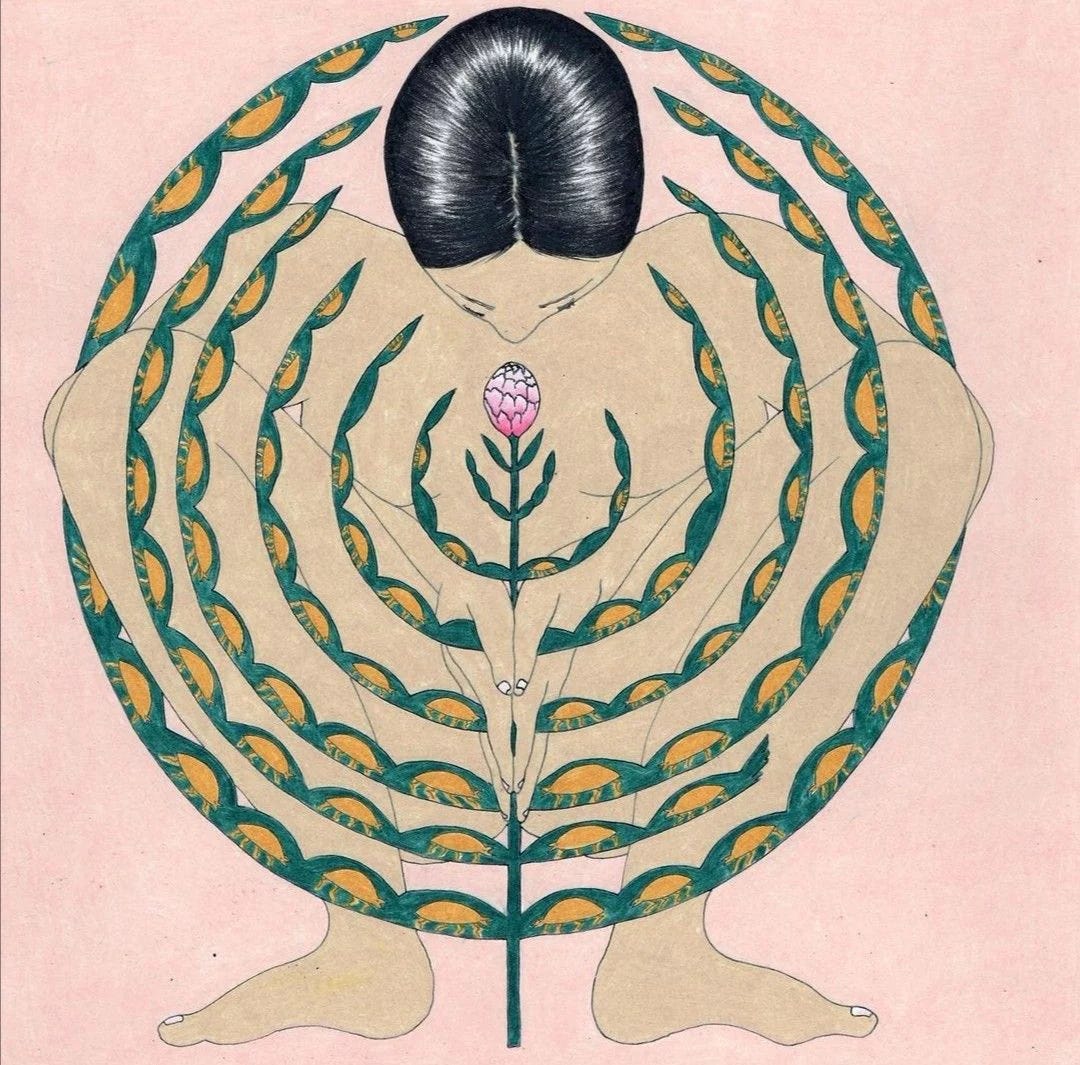
A seed knows how to wait. Most seeds wait for at least a year before starting to grow; a cherry seed can wait for a hundred years with no problem. What exactly each seed is waiting for is known only to that seed. Some unique trigger-combination of temperature-moisture-light and many other things is required to convince a seed to jump off the deep end and take its chance—to take its one and only chance to grow.
Each beginning is the end of a waiting. We are each given exactly one chance to be. Each of us is both impossible and inevitable. Every replete tree was first a seed that waited.—Hope Jahren, Lab Girl: A Story of Trees, Science and Love
I begin writing this on my birthday—a natural inflection point, a cyclical threshold that invites us to reckon with the slow, yet somehow speedy, passage of time. These days, I look in the mirror to find subtle lines of a life well lived on my face, a new dust of freckles spattered across my cheeks, a crowd of white strands nesting themselves in my otherwise dark hair.
I peer into my reflection on this beautiful dawn, which is somehow the same as all others, yet markedly different, and I think of all that I have lived—countless joys and sorrows that I could never have imagined, even in the most potent of dreams. The places I have travelled, the people I have met, and the love that I have received percolating forth in a dynamic constellation of gratitude.
Yet, there are many visions I hold close like seeds in my chest that have yet to take root. I have to accept that some may never sprout, feeling them there in their potentiality nonetheless. There are some dreams that will never find good soil, others for which there will not be enough moisture, sunlight, or oxygen, and some that, for whatever reason, are simply not destined to sprout.
I turn thirty-one today, entering a year deeper into the fourth decade of my life as a single woman without children. I had always imagined that I would have a family by this age. One, or perhaps even two to three ruddy-faced children bustling around my house. Even though I’m not much of a planner by nature nor do I consider thirty-one to be “old,” I somehow find myself captured by common currents, swayed by perceived societal pressures to hit certain milestones by a designated age, caught in the fever of “now or never.”
It’s true parenthood is not for everyone, with a great many consciously deciding to opt against having bringing new life into this world for feelings of conflict about these times of crisis that only ever seem to get worse. More than that, many individuals are simply not interested in having children; they don’t have that desire, with a great many other quests igniting their souls. However, for me, the idea of motherhood has long existed as a site of spiritual yearning.
In my personal trajectory, motherhood calls to me as an alluring portal into another world; into another self. Without having borne a child in my womb, I am able to somatically sense into the miracle of walking this Earth with two heartbeats instead of one; my locus of care transforming into something more porous, entangled, and greater than this individually-bounded self. Far beyond the ancient biology that urges us to cast our ancestral lineages into the future, there is a quiet, yet undeniable knowing that to be a mother is one of the ways in which I could love this world a little more deeply.
I know a handful of women, and even men, my age who find themselves in similar positions, our bodies and perhaps minds propelled by a sense of urgency to act within a perceivedly ever-narrowing window of time. Yet we do not want to have children just for the sake of it. Deep down, there is a knowing and trust that the timing needs to be right. To grow and tend to new life is so delicate, precious, and profound that it asks not to be rushed. Like a seed, one must learn to wait.
Rather than fret or despair about something that hasn’t happened yet, or perhaps very well never will, I can lean into the discomfort of uncertainty. Although the unknown can be scary, there is also excitement inherent in the unfathomable possibilities of this life. As I write, I know that a great many seeds lie dormant in the soil, waiting patiently until the conditions are just right.
Each seed is brilliant in its individual uniqueness, with what triggers a seed to begin developing varying widely across species. For example, some plants in wildfire-prone ecosystemcs have evolved to develop “fire-enhanced” or “fire-dependent” germination responses, with certain seeds stored in cones to protect them from hungry creatures, only releasing after fires, and others that release when ripe, waiting for the signal of heat or smoke before sprouting. Other seeds hitch rides in the bellies of animals, their germination aided by the journey through a digestive tract. More than that, seeds tend to germinate in the dark. Long before signs of new life are visible, they take root in places that extend beyond the limitations of vision or sight.
Entangled with this feeling of urgency tied to my possible future progeny is the fierce weight of these times. Everywhere I turn, I am confronted again and again with the manifold crises of our world. From flash floods to rampant wildfires, plane crashes to political collapse, global warming to live-streamed genocides, I find myself perpetually overwhelmed, exasperated, and heartbroken, feeling a desperate need to make a change before it is “too late.”
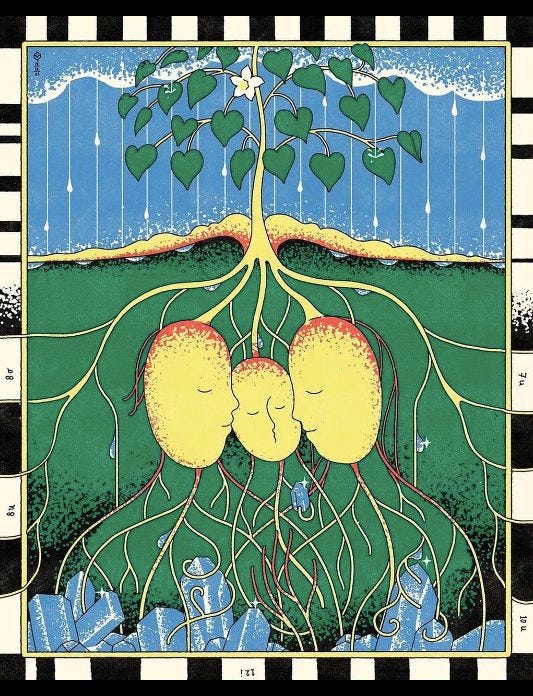
A wise Lakota elder, my uncle through ceremony, Sandor Iron Rope, once told me, “Be ready. I cannot tell you for what, but start preparing yourself so when the time comes, you know how to act.” As I hold his guidance in my heart, I think about birthing children, tending seeds, and shaping possible futures, asking the question: How can I ( and by extension, we as a species) support the conditions in which new life takes root?
I use the word “support” and not “create” very intentionally because we, in our industrialized, globalized world, often inhabit anthropocentric ontologies that decenter agencies that exist outside of our own. It is audacious and aggrandizing to think that life is ours to control or create.
Exploring the tension between slowness and urgency, philosopher Bayo Akomolafe implores, “The times are urgent; let us slow down.” For Akomolafe, “The idea of slowing down is not about getting answers, it is about questioning our questions. It is about staying in the places that are haunted. One of such haunted spaces is the idea of anthropocentricity – or the humanism that treats human beings as the center of the universe. What that philosophy excludes is the participation, contributions and collective creativity of the world at large.”
In the same way, it takes more than our will for a seed to sprout or a bud to blossom, allowing for the myriad agencies of other beings, seen and unseen, to form part of the process that is this miraculous life. Where do dreams go to be planted? In which tomorrow will they sprout? We may tend the seeds and till the soil, but the movements of the sun, wind, and rain belong to themselves in an unpredictable elemental dance.
When I was in secondary school, I volunteered with the younger classes, spending my free periods with children aged four to five. At the time, I wore braces, and one of the little boys that I was minding, Christopher, gazed curiously at my teeth. I noticed a spark as it grew in his eyes, sensing a question forming in his mouth. He stood close to me, lifting his hand and gesturing his little pointer finger towards my face. “What are those metal things on your teeth?”
I explained that they were braces and that I needed to wear them because my teeth were crooked and I wanted them to be straight.
“But when will you get them taken off?” he asked, still effervescing with interest.
“I don’t know,” I replied. “At some point in the future.”
Then, to my surprise, he questioned earnestly, “What is the future?”
I was disarmed, caught off guard by this most simple yet illuminating questioning of a concept that I had long unconsciously taken for granted. I took a moment to pause, trying to think carefully about what I’d say next. “Well, the future is any moment after now… It is tomorrow, the day after, and then the day after that,” I stuttered.
“But how do you know if it is real, if you can’t see it, smell it, taste it, or touch it?”
Truthfully, Christopher’s question has remained with me as a gift throughout the years. We cannot truly know that the future is real, and yet it is undeniable that what happens in any given moment plays a role in what is to bud, unfurl, or wither in the next. This moment, itself a seed, contains within it all other moments to come, as well as many we will never know.
The future of our planet, the children I so wish to bear, every latent tomorrow—they are all simultaneously hidden and emergent. It is beyond our grasp, sometimes beyond our imagining, but deep in the Earth, in the darkest of soil to whose depths we do not venture, secret worlds are taking shape.
We cannot know what will happen to this one, precious planet whose lifeblood pumps animacy through our veins, nor can we know what will happen to our species, and countless other forms of life, as we move through these precarious times. Seeds, our children, tomorrow, none of it is promised to us, and rather than fall into hopelessness at this realization, we can instead use it to propel our actions.
We cannot ensure birth or new life taking root; we can only tend to it. With my loving devotion, I walk the garden path every day, watering the plants, turning over the compost, pruning a branch here, loosening a weed there. With continued dedicated action, I listen to how to prepare a supportive container for life to expand.
I till the Earth, use my fingers to burrow tiny holes destined as new homes, beginning places for the seeds I am to sow. I scatter them, watering intermittently, but more than anything, I wait patiently.
Even after all the tending and waiting, I can’t be certain that anything will happen, and so I begin to exercise faith. I stretch my hope, I dream the dream. I don’t know which seeds will change shape and become something else, and which ones won’t and why, but it doesn’t matter. Even when it seems unlikely or impossible, I believe and trust that life will take root where it needs to.
Within weeks, signs of life become visible. I could not tell you in advance which seeds would sprout first, nor which would be slower or remain dormant in the soil, only that I tended to them, waited, and surrendered to trusting the process. I place a hand on my belly. There is no way of knowing for sure, but in the meantime, I’ll be in service to that impossible and inevitable unknown.
I've felt similar in many ways - since being young I've wanted kids, and dream often about that relationship.... thank you for these words
Birthday blessings, may you mother beloved.